

The UK’s specialist Electrician SEO company
Electrician SEO that actually fills your diary. Leads don’t grow in 90 days? The next 90 are on me. Fair? When someone Googles “emergency electrician” or “EICR in your town”, I make sure they find you. SEO is £750 a month flat, with no long contracts.
★★★★★ 5.0 · Google reviewsQuiet phones turned into full diaries
This is what good SEO for electricians should deliver: more phone calls and more booked jobs, not vanity traffic. Real results, for real electricians across the UK.
★★★★★ 5.0 on Google · read all reviews
“Great service, cheers Jack.”
“Can’t thank Jack and the team at Electrician SEO Pro enough. I came across them while trying to figure out SEO myself…”
“I’ll be honest: I was sceptical about SEO. I’ve tried marketing companies in the past that promised a lot but delivered nothing. Electrician SEO Pro has been different. Jack knew exactly what needed doing, and it’s genuinely changed my business. Thank you!”
SEO services for electricians, without the dressed-up nonsense
Every week, someone emails you promising #1 on Google. £1,899 a month, 12-month contract, results “guaranteed.” Six months later you’re still wondering where the leads are, and why nobody picks up when you ask.
I’ve spent 7 years inside that industry. Most SEO sold to trades is built to look good on a report, not to put work in your diary.
I’m Jack. I run Electrician SEO Pro. One trade, done properly. Whether you’re a registered electrician doing domestic rewires or a commercial electrical contractor chasing bigger fit-outs, the approach is the same: get found by the people ready to book. If it’s not a fit, I’ll tell you straight.
“If your leads haven’t gone up in 90 days, the next 90 are on me.* I can say that because it’s one trade, done properly, not a content mill spraying the same blog at plumbers, roofers and electricians.”
More leads in 90 days, or the next 90 are on me
No 12-month lock-ins. No hiding behind “proprietary” dashboards. If the enquiries haven’t grown, the next 90 days are on me.

Honest answer? I got tired.
Years of doing SEO for e-commerce brands flogging stuff nobody needs, agencies who’d take a client’s money and ghost them, founders who treated their staff like dirt and wanted to look like saints online. After a while it gets to you.
Given the choice between helping a hedge fund rank for “best ESG portfolio” or helping an electrician in Manchester get the rewires he actually wants? Easy decision.
The goal is 500 electricians with more leads by 2030. Want to be one of them?
More free electrician SEO guides
Short, practical reads on getting your electrical business more calls from Google. No jargon, no theory, just what actually moves the needle.
SEO for Electricians: The Complete Guide to More Leads (2026)
The full top-to-bottom guide, keyword research, on-page, technical, local SEO, links and tracking, everything that turns Google into booked jobs.
Read more Keyword researchKeyword Research for Electricians: Full 2026 Guide
Why electricians struggle to rank even when they “do keywords”, and the research method that actually surfaces job-winning searches.
Read more Paid adsElectrician Ads: What Paid Ads Work in 2026 (Sorry, SEO is King)
Which paid channels are actually worth it for electrical businesses, and why SEO still wins long term.
Read more Google AdsGoogle Ads for Electricians: Mega Guide (2026)
One of the fastest ways to get more calls from ready-to-book customers, set up the right way.
Read more Advertising17 Electrician and Electrical Contractor Advertising Ideas That Work in 2026
Practical, results-driven ways to market an electrical business in today’s market.
Read more Facebook AdsFacebook Ads for Electricians: 2026 Guide to Running Profitable Campaigns
How to set up Facebook campaigns that bring in qualified leads, not just cheap clicks.
Read more Branding69 Electrician Advertising Slogans That Don’t Suck
Memorable taglines to help your electrical business stand out and stick in customers’ heads.
Read moreHow to do SEO for electricians (yourself)
PSST… here’s everything I’d do, laid out step by step, so you don’t have to pay me or any other SEO a penny. Yes, the worst businessman ever. Let’s dive in.
Why SEO is a must for electricians
People search Google for electricians over 185,000 times a month in the UK. That’s a ton of potential jobs up for grabs.
Demand for electrical work is steady, so you need an SEO game plan that targets the right local keywords in your service area(s). Whether you’re just starting out or have years in the trade, a solid strategy brings in more customers wherever you work.
Sure, word-of-mouth and repeat clients are king. But beyond that, you need a system delivering leads around the clock. SEO does that, and it all starts with keyword research.
Conduct electrical keyword research
Here’s how to find the search terms that get your business ranking on Google Maps (the local pack), in your Google Business Profile, and in the standard organic search engine results pages (the SERPs). These are also the keywords you’d plug into Google Ads.
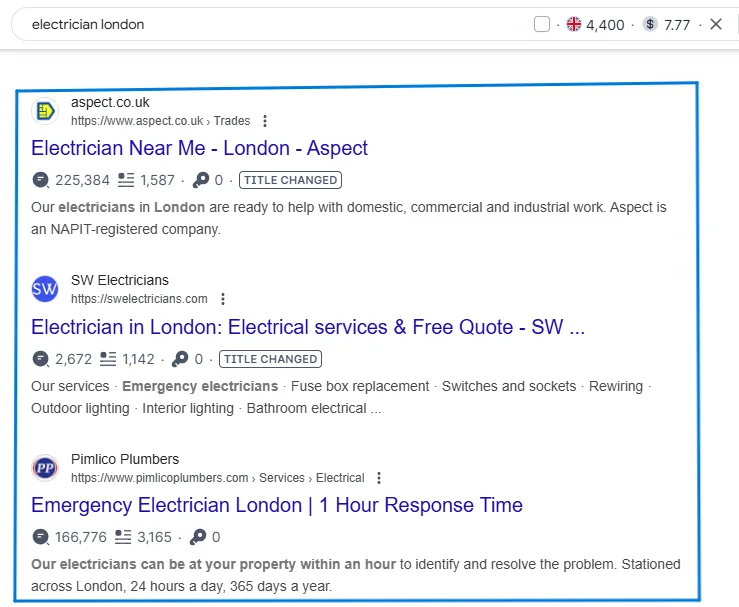
Done right, the “triple-threat” puts your business front and centre across every result a searcher sees:
- #1 in Google Ads, sits above everything else on the page.
- #1 in the local pack, the Google Maps listings, powered by your Google Business Profile.
- #1 in organic results, the traditional website rankings.
Lock down all three and you leave competitors with nothing. Forget “page one” as a target, that’s old news. Aim for the top 3 across all your assets to max out click-through rate.
How to actually do it
Don’t wing it. Open Google Keyword Planner, click “Discover New Keywords”, type something broad like “electrician” plus your town and hit Get Results. It spits out terms people in your area actually search. Don’t stress about optimisation yet, just build a solid list of commercial keywords (where the intent is to hire).
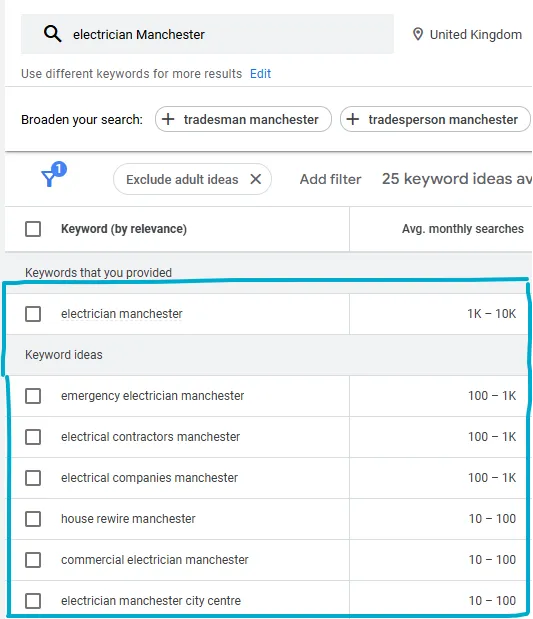
Intent example: someone searching “emergency electrician in Manchester” isn’t browsing for fun, they need you now. Those high-intent terms deliver the best bang for your buck.
Match the search intent
Search intent is the bit most people skip, and it’s the most important. Intent is what the searcher actually wants, and it splits roughly three ways:
- Commercial / ready to hire, “emergency electrician Manchester”, “house rewire cost Leeds”. They want a tradesperson now or very soon. This is your bread and butter, target it first.
- Informational, “why does my fuse box keep tripping”, “do I need an EICR to sell my house”. Not ready to book yet, but answer them well and you’re the name they trust when they are. This is what blog content is for.
- Navigational, someone searching your business name. Small, but make sure you own it.
Match the page to the search intent and you win. Put a “book now” service page in front of someone asking “what is an EICR” and you lose them; give them a clear, helpful answer and you’ve started the relationship.
Top keywords for electricians to target
When your site’s new, start with lower-competition phrases. As you gain traction, go after the tougher ones. Want the lot? All 198 are in my free electrical keywords list.
Write each service the way customers actually search it: some Google “consumer unit upgrade”, others type “electrical panel upgrade” or “fuse board replacement” for the same job, so cover the variations rather than betting on one.
- electrician + town
- electrician near me
- electrical contractor near me
- emergency electrician + town
- domestic electrician + town
- commercial electrician + town
- electrical repairs + town
- rewire house + town
- electrical installation + town
- PAT testing + town
- fuse box replacement + town
- consumer unit upgrade + town
- generator installation + town
- lighting installation + town
- EV charger installation + town
- electrical safety check + town
Optimise for on-page SEO
You’ve got your keywords, now use them. (For the full detail, there’s a dedicated on-page SEO guide.) But first, sort your structure.
Website structure vs URL structure
Website structure is how pages link together, especially through your main navigation. Your key services, “emergency electrician”, “house rewiring”, should sit in your sitewide nav, paired with your primary location. That helps Google crawl and index them, and makes it dead simple for customers to find what they need.
URL structure is how you build the web address itself, not the links. There are two ways to play it, depending on your size:
- No folders. Keep it clean off the root domain (e.g.
yoursite.co.uk/emergency-electrician-bristol). I use this myself for simplicity, it’s the same structure as the page you’re reading right now. - Folders. Good for targeting multiple areas (e.g.
yoursite.co.uk/uk/england/bristol/electrician-services). Think big firms like Siemens, drilling down by country, region and town.
Whatever you pick, get your main keyword in the URL.
Then give every page structured content: one clear H1, descriptive H2s and H3s, short paragraphs, and lists where they help. Structure isn’t decoration, it’s how a reader scans your page in five seconds to decide if you can help, and how Google works out what each part of the page is about. A wall of text loses both.
Build solid, local content
“Content” covers every page, service pages, about us, blogs, all of it. Each one needs a structure that matches what the searcher wants. “House rewiring in Glasgow” → a service page built to turn visitors into booked jobs. “Average cost of rewiring a house in Glasgow” → a blog post packed with useful info.
Too many local electricians mess this up. They chase vague national terms like “what is rewiring” and wonder why the phone’s quiet. Those terms won’t rank for you, and they don’t hit your local crowd anyway, even if you did rank, you’d get jobs from all over when you only work up North. So stay in your lane; your bank balance will thank you.
The fix: target your service and location with unique pages, and get as local and data-driven as possible. For an electrician in Leeds, that might be:
- What’s the Average Cost of House Rewiring in Leeds?
- How Many Electricians Work in Leeds?
- The History of Electrical Services in Leeds
- Future Tech: Smart Home Installations in Leeds
The on-page checklist (with Yoast)
- Set your focus keyword in the Yoast box (e.g. “house rewiring Birmingham”).
- Build a strong outline, use ChatGPT to draft intro, cost factors, process, local considerations and FAQs.
- Craft a killer title with the keyword near the start, under 60 characters.
- Write a meta description with a hook and the keyword, capped at ~155 characters.
- Use the keyword in your H1 naturally.
- Drop it in the first line, keep it natural, don’t jam it in.
- Sprinkle it in subheadings (a variation in an H2).
- Work it into the text 2 to 4 times across 800 to 1,200 words. Don’t overstuff, keyword stuffing is the fastest way to write a page for robots that real customers bounce straight off.
- Optimise the URL so the keyword’s there, no clutter.
- Check Yoast’s feedback, fix anything orange or red.
- Add internal links with smart, keyword-rich anchor text (never “click here”).
- Publish and test, Google your keyword in quotes after a few days and adjust.
Do this properly and you’ll leave plenty of electrician sites, aka your competitors, in the dust.
Technical SEO
Technical SEO is the plumbing behind your rankings, the stuff that lets Google find, read and trust your site. You don’t need to be a developer, but if the foundations are broken, none of the content work lands.
- Crawling & indexing. A clean XML sitemap, sensible internal links and no stray “noindex” tags mean your service pages actually get found. The Pages report in Google Search Console shows what is and isn’t indexed.
- Schema markup. Schema (structured data) tells Google exactly what something is instead of letting it guess. A LocalBusiness or Electrician schema markup block spells out your name, address, phone, hours, service area and reviews; add Service schema to service pages.
- HTTPS & a clean setup. A padlock, no broken links, no duplicate versions of the site fighting each other. Basic hygiene a surprising number of trade sites get wrong.
- Core Web Vitals. Google measures real loading speed and stability, so a mobile-friendly site and good website speed are ranking factors, not nice-to-haves.
Get the technical SEO foundations right once and everything else you do works harder for it. See the full technical SEO guide →
Conversion & UX (turning visitors into customers)
Once your content plan’s nailed, focus on the user experience, because ranking is pointless if visitors don’t pick up the phone or fill in a form. You need a responsive design that works on phones, tablets and desktops, set up to make enquiring as easy as possible. This is conversion rate optimisation (conversion optimisation for short), the small changes that turn more of the same visitors into booked jobs, and often the cheapest win in SEO.
- Put your phone number up top, in the header or just below, and make it tap-to-call on mobile for max enquiries.
- Stick booking forms or buttons high up on every service page. You’re ranking to get leads, so make it dead easy.
- Sort your homepage. Customers should see straight off that you’ve got experience, a proven record, that you’re a licensed electrician with proper quals (like NICEIC), and cracking reviews.
- Set up call tracking. Use a tracking number or call tracking software so you know which calls came from SEO versus a leaflet or a referral. Without it you’re guessing what works, and guessing is expensive.
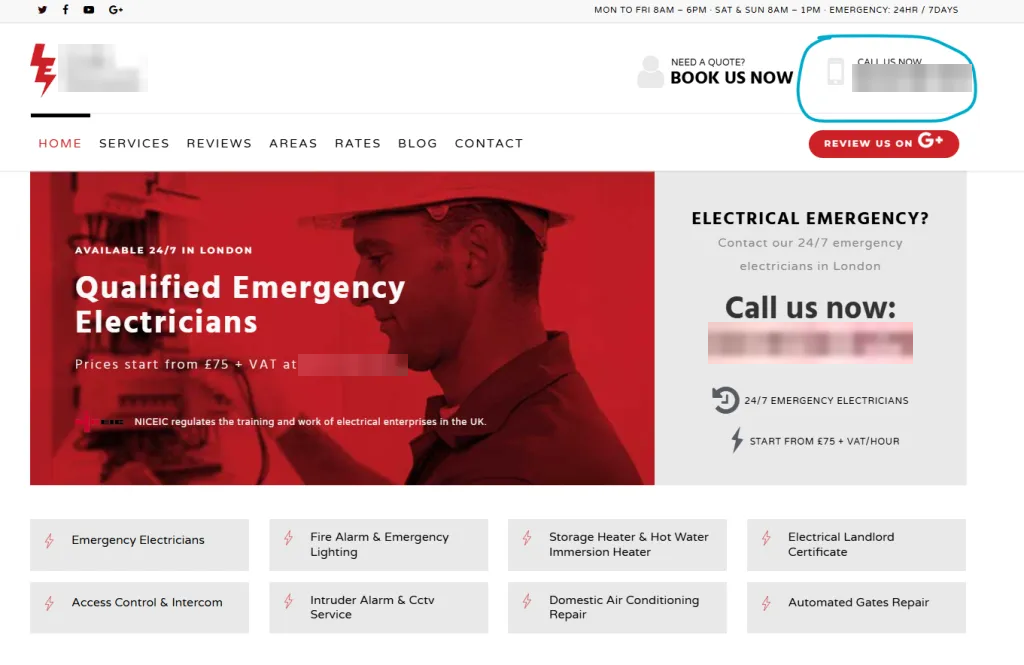
This ties into Google’s E-E-A-T: Experience, Expertise, Authoritativeness and Trustworthiness. Don’t hold back on flexing your skills, and make sure blogs come from, or are vetted by, a real pro. You’ve got that covered: you’re an electrician.
Make it fast and mobile-ready
It all has to work smoothly on mobile. Themes like GeneratePress give you a mobile-ready setup from the off, though I’d still get a designer and developer to tweak it right. The other biggie is load time, test yours with Google PageSpeed Insights. Under 80? That’s a problem; sort it ASAP.
Local SEO, the Google Map Pack & citations
For most electricians, local SEO is the whole game. The Google Map Pack (also called the Google Local Pack), the three map listings that sit above the normal results, takes the lion’s share of the local search clicks, because it’s right there with the phone number, reviews and “open now”. Win the Map Pack and you win the day, and the full local SEO & Google Business Profile guide goes deeper still. Here’s what moves it:
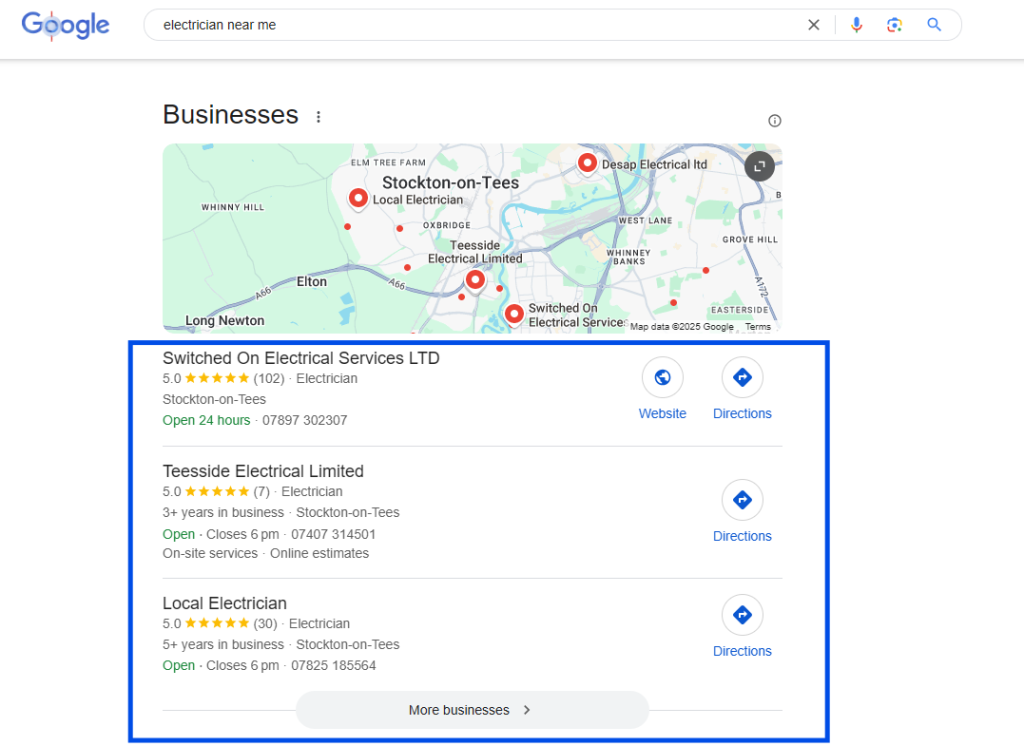
- Google Business Profile optimisation. Your Google Business Profile (formerly Google My Business) is the single biggest local lever you have. You need a real address in your target town (no address there, no Map Pack, no exceptions), then optimise everything: the right primary category (Electrician), every service listed, real photos of your work and van, accurate hours, and a description packed with what you do and where. Google Business Profile optimisation is ongoing, not a one-off.
- Service area pages with hyper-local content. If you cover five towns, build a proper page per town, not the same page with the name swapped. Genuine hyper-local content wins: the postcodes you cover, jobs typical to that town’s housing stock, a recent job nearby. That’s the difference between a page Google ignores and one that ranks.
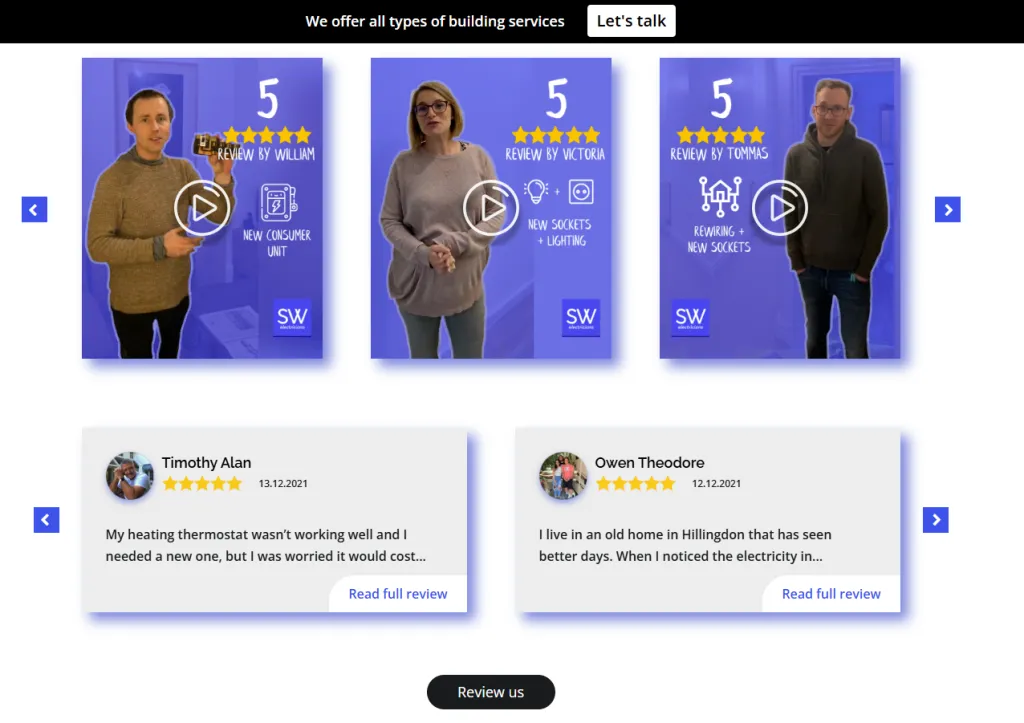
- Google reviews. Volume, recency and rating all count. Make asking a habit: text the review link the moment a happy customer pays, and reply to every review, good or bad. Never buy fake reviews, Google spots them and the penalty isn’t worth it. Google reviews are local-ranking fuel, and protecting your online reputation is part of the job, not an afterthought.
- Local citations and NAP consistency. A citation is any mention of your business details on another site. Build local citations on the UK directories that matter and keep your NAP (Name, Address, Phone) identical everywhere across Yell, FreeIndex and the rest. A mismatched phone number or an old address quietly drags your rankings down, that’s why NAP consistency matters.
- Local Service Ads. Google’s Local Service Ads (the “Google Verified” badge listings) sit right at the very top and you pay per lead, not per click. Still rolling out across the UK trades, so check whether they’re live for electricians in your area. A strong top-up, though your organic local SEO is what you actually own.
Content marketing for electricians
Content marketing isn’t blog content for the sake of it, and it’s not churning out thin words to “feed the algorithm”. The point of content creation is simple: answer the questions your customers ask before they book, so by the time they need an electrician, you’re the one who already helped them.
The most effective approach is topic clusters: a strong service page (say, “house rewiring in Glasgow”) supported by blog posts answering the questions around it, all linked together. For an electrician in Leeds that cluster might be:
- What does a full house rewire cost in Leeds? (the money question everyone Googles first)
- How long does a rewire take, and do I need to move out?
- Signs your house needs rewiring (the self-diagnosis post that turns worry into a booking)
That’s real customer education: you teach, you build trust, and the internal links funnel the reader to the page that books the job. Lean on seasonal content too, fuse-box and safety checks before winter, EV charger demand around new-plate season. One genuinely useful page keeps pulling leads for years; that’s why content compounds while ads stop the moment you stop paying.
Why backlinks matter for electrician websites
Backlinks, links from other sites to yours, are word-of-mouth in the digital world. When a decent site links to you, it’s like a mate vouching for your skills, and Google bumps you up. But it’s not about getting any link, relevance is the key, as the full off-page SEO guide explains.
Why relevant links are a must
- Trust signal. A link from a local trade group or supplier screams you’re legit, Google loves that.
- Local edge. Links from your area (say, a Bristol builder) tie you to your patch and boost your local-pack odds.
- Right customers. Relevant links, trade sites, home-improvement pages, send people who actually need an electrician, not tyre-kickers.
- Penalty shield. Irrelevant or spammy links can get you whacked by Google and dropped off the map fast.
Relevance beats quantity
A single link from a local plumber’s site outweighs 20 from dodgy directories. A link from “Joe’s Plumbing in Leeds” for a job you did together tells Google you’re active and trusted in Leeds. A link from a random overseas casino? Useless at best, toxic at worst. Relevant links mean higher rankings, better traffic, and impact that keeps paying off instead of fading or backfiring.
How to actually get them
Build something worth linking to, a quick guide, a job rundown, a cost cheat sheet, then reach out by email, call, or over a pint with a local contact. Aim for 3 to 5 solid links over months, not a flood of rubbish. If that’s not your thing, get clients you’ve done work for to write up a case study on their site and link back to yours.
Trick electricians use all the time: sponsor your local football team. You score a local link, support your community (which looks cracking to the public), and get your name out there. Chatting up local journalists for an interview works a treat too.
Analytics & reporting for electricians
Top outfits hook up Google Analytics and build a dashboard to track what’s working, the full tracking & reporting guide breaks it down. There are two types of metric to watch:
- Leading metrics, the stuff you control, like pages published or backlinks earned. These should tick up steadily each month.
- Lagging metrics, the payoff from that effort. Today’s wins (or flops) come from what you did weeks or months back. For local SEO, watch impressions, website clicks and phone calls from your Google Business Profile.
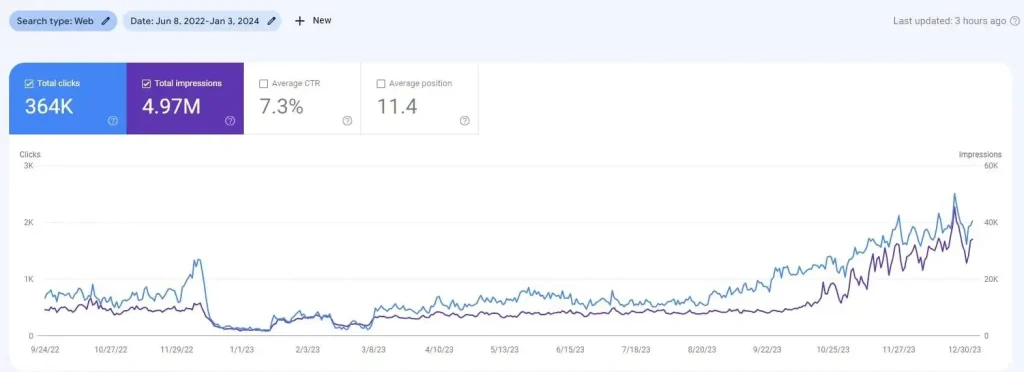
That said, the metric you should really care about is simple: how many leads you’re getting each month. That’s what tells you whether it’s actually working.
AI search, AI Overviews & voice search
Search is changing faster than it has in twenty years, and the trades aren’t exempt. Here’s what’s actually happening, without the hype.
AI Overviews (AI-generated summaries)
Google increasingly answers questions with an AI-written summary at the very top, pulling from a handful of sources it trusts. You can’t buy your way in. What gets you cited is being a genuinely clear, well-structured source: answer the question directly in the first line, use plain headings and lists, add FAQ sections, and back it with schema markup. The same good content that ranks organically is what gets pulled into the AI answer.
Voice search
More people talk to their phone or a smart speaker: “find an emergency electrician near me that’s open now”. Voice queries are longer, spoken in full sentences, and almost always local and urgent, which plays straight into an electrician’s hands. Keep your Google Business Profile flawless and your hours accurate, build FAQ content that answers questions the way people say them out loud, and make sure that mobile-friendly site loads instantly.
What “AI SEO” actually means
There’s no magic trick, and anyone selling you “AI SEO secrets” is having you on. AI SEO just means writing content so genuinely helpful, specific and well-organised that both people and AI models understand and trust it. Real expertise (you’re an actual electrician, that’s your edge), clear answers, named services, schema markup and internal links. The clearest, most genuinely useful electrician in your town wins, online and off.
Picking the right SEO agency
You’ve got two options here. Do it yourself, I’ve given you plenty to work with today, or leave it to a professional and invest in SEO for your electrical services. If you go the agency route, loads of outfits serve trades, but not all are worth your time. Grill them with these:
- “What’s your SEO process?” If they skip keyword research, competitor analysis, technical fixes, on-page, content and link-building, you’re getting a half-baked job.
- “How do you report?” A solid agency shows the full picture, leading and lagging metrics, every month. Beware “proprietary” waffle.
- “How do we stay in touch?” Insist on regular updates, not a report once a month and a ghost. You wouldn’t check in with your crew once every 30 days.
- “How much does it cost?” Get a clear monthly price up front. Mine is £750 a month flat, with no long contracts.
Knowing how SEO works helps you spot a decent agency. But just like you wouldn’t tell a client to rewire their own fuse box, DIY SEO’s a gamble. If you’d rather hand it over, that’s exactly what I do, done-for-you Electrician SEO, backed by the 90-day lead guarantee.* I’ve got your back.
Electrician SEO FAQs
What is electrician SEO?
Electrician SEO, also searched as SEO for electricians or simply SEO electrician, is the work of getting your electrical business to the top of Google for the jobs you actually want, in the towns you actually cover. It pulls together your website, your Google Business Profile and your content, all aimed at one outcome: more booked jobs.
Is SEO for electrician websites really worth it?
In a word, yes. SEO for electrician websites pays for itself the moment it lands a job you wouldn’t have won otherwise, and unlike paid ads, it keeps working after you stop spending.
Should I hire an electrician SEO agency or do it myself?
Both can work. The guide above gives you everything you need. But if you’d rather be on the tools than buried in Google Search Console, electrician SEO experts who live and breathe one trade get there faster, that’s the case for a specialist electrician SEO agency over a generalist who treats your trade like every other.
How much do electrician SEO services cost?
With Electrician SEO Pro, electrician SEO costs £750 a month flat, with no long contracts. The real question isn’t what it costs, but what a booked rewire is worth: for any electrician company, SEO that pays for itself is a no-brainer. And as an electrician SEO company that does one trade only, mine is backed by the 90-day lead guarantee.*
Let’s fill your diary.
Send me a WhatsApp. If it’s not a fit, I’ll tell you straight. If it is, your leads grow in 90 days, or the next 90 are on me.